
The Judging System

To secure Breaking a position in the Paris 2024 Olympic Games, the Trivium judging framework was used to train judges and the Trivium judging interface was used on handheld tablets to register decisions for scoring in events. Both the framework and the interface have undergone years of rigorous development, testing and independent auditing in order to meet the cultural, artistic and competitive demands of Breaking, and the official requirements of the International Olympic Committee, having been deployed at the Buenos Aires Youth Olympic Games in 2018. The Trivium interface and framework were created by veteran Breakers who have dedicated decades to the dance and hold its cultural legacy in high regard. These were created for the culture, by the culture.
The Framework

Judging with the Trivium framework is holistic and comparative. Judges compare imbalances in performances and register them across six domains, which are grouped into three sets of qualities: Physical (body), Artistic (mind), and Interpretive (soul).

Physical Domain (Body)
Domains: Technique & Variety
Who showed better technique, variety, control, and execution.
These qualities are connected to physical training and ability of the dancer’s body.

Artistic Domain (Mind)
Domains: Creativity & Personality
Who showed better creativity, displayed a clear character and personality and was better able to adapt and personalise the dance?
These qualities are choices and a product of the dancer’s mind.

Interpretive Domain (Soul)
Domains: Performance & Musicality
Who had a better performance reaction to the moment, the music and their opponent?
These qualities encapsulate the ability of freestyle and being in the moment that we often call the dancer’s soul.
The Interface
The judging interface is a digital tool (developed with and8) used on handheld devices such as tablets or smartphones. Rather than relying on rigid checklists, fixed benchmarks, or absolute point scores, it is designed to capture direct, real-time imbalances between two competing dancers across a round—translating a judge's observations into transparent, visual data for competitors and audiences.
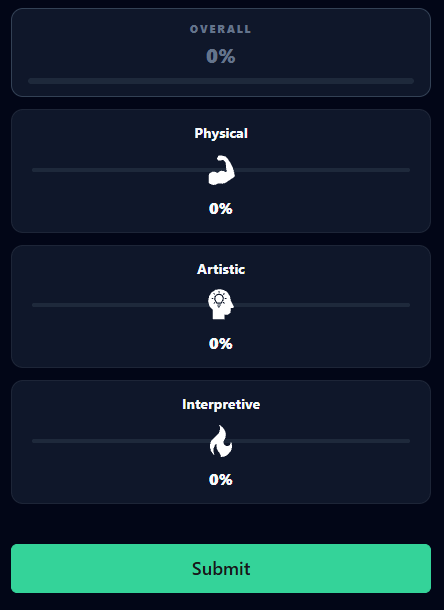
Threefold Interface
Features three crossfaders representing the three overarching qualities—Physical (Body), Artistic (Mind), and Interpretive (Soul)—each weighted equally at 33.33%.
Because it captures three broader data points and includes on-screen quality reminders when a slider is touched, it is accessible and well-suited for judges with less experience.
Trivium Interface
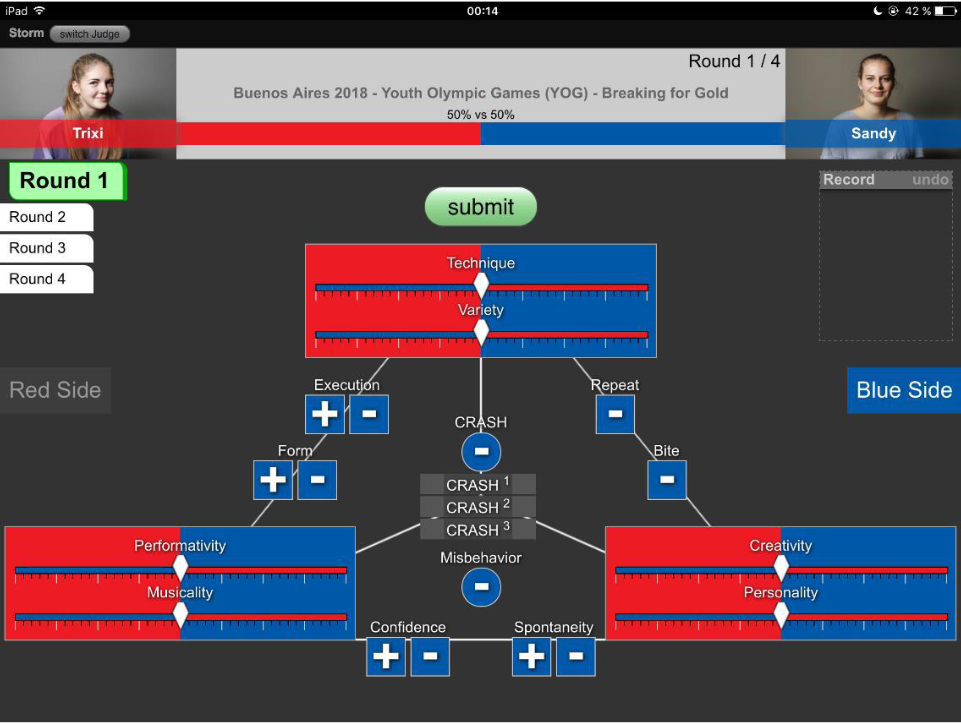
A higher-definition version featuring six crossfaders that unfold the three overarching qualities into six specific domains: Technique (20%) and Variety (13.33%) under Physical; Creativity (20%) and Personality (13.33%) under Artistic; and Performance (20%) and Musicality (13.33%) under Interpretive. It also includes affect/shortcut buttons—positive and negative buttons (Form, Execution, Spontaneity, Confidence) that adjust multiple crossfaders simultaneously, alongside penalty buttons (Crash, Repeat, Bite, Misbehaviour).
Due to its granularity, using the Trivium interface for competitions requires dedicated training and experience.
Example
The DJ starts playing a break signalling the start of the battle. Breaker 1 starts dancing, throwing down a challenge to breaker 2, which the judges observe with consideration of the three domains. The dancers are free to express themselves to the music how they choose, but it must be rooted in the style of breaking. When breaker 1 has finished, breaker 2 dances their response and the judges immediately start to compare the physical, artistic, and interpretive qualities of both dancers; they are not looking for specific moves to be included. Once the second breaker finishes, the judges use a digital interface to input their evaluation, comparing breaker 1 against breaker 2. The interface has a set of crossfaders representing the domains along with additional shortcut buttons. Crossfaders are moved in favour of the breaker who embodies the domain better. As it is a comparison, the judges must make decisions about which performance was superior, thus the system does not permit a draw. All judges adjudicate all domains, ensuring that the performances are judged in their entirety rather than specific judges focusing on specific aspects.
Each exchange between breaker 1 and 2 is one round. The winner of the round is the breaker who the majority of judges deem better than the other. The dancer that wins the majority of rounds, e.g. best of 3, wins the battle and advances in the competition.
The results of the first round are displayed immediately so that competitors and audience can see who is leading as the next round starts. The immediacy of the results being displayed after each round whilst the battle progresses adds to the tension and excitement for competitors and viewers. Thus the system encourages audience engagement for novice and experienced breaking viewers alike.
Comparative adjudication of the three domains permits the judges to determine who is the best B-boy or B-girl as a complete, holistic representation of breaking.
The role of F.A.C.T.S.
The system is fair; equal weighting is given to each domain therefore it does not favour specialists in one particular domain, but seeks to reveal which competitor is better overall using objective comparison of core breaking values. This reduces the likelihood of judge bias towards certain elements. There is an awareness and reduction of bias and personal preference.
There is accountability; the system permits all decisions to be tracked and evaluated. In the interest of fairness, judges must be held accountable for their decisions.
The system encourages consistency through coherence in terminology and judging; all judges undergo a training and certification process which encourages a reproducible and consistent approach to assessing breaking holistically.
It is transparent; the system provides immediate feedback for competitors and audiences. Judges’ decisions are documented, e.g. a dancer can see which value(s) cost them the win, and promotes audience understanding. Furthermore, this clarity permits judge bias to be highlighted and addressed accordingly.
The system is backed up by statistics. A report is produced on and8.dance for every event that uses the system which is openly accessible for public viewing. This report includes the statistics for each judge which further supports its accountability.
Trivium does not encourage breakers to include specific standardised movements, instead it promotes a holistic approach to push the boundaries of physicality, artistry and interpretation, comparing each dancer to their opponent within the cultural framework of breaking.